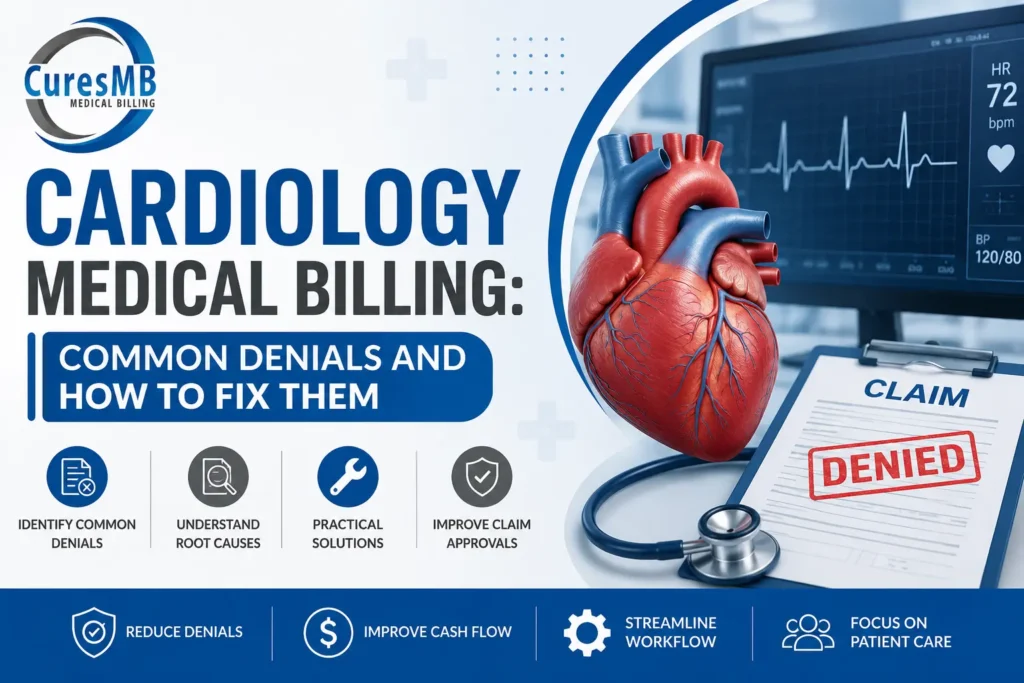
A single missed catheterization code can cost your cardiology practice $500 to $700 in one claim alone. Multiply that across a busy month, and cardiology medical billing mistakes start looking less like small errors and more like a real revenue problem. Dedicated cardiology billing services exist because this specialty carries some of the highest denial rates in healthcare, driven by strict bundling rules, layered modifier requirements, and procedures that split between technical and professional components depending on where they happen.
You may already sense this in your own AR reports. Echocardiograms bounce back for missing documentation elements. Stress tests get denied because the wrong global code was billed in a hospital setting. Cardiac device claims stall over authorization mismatches. None of these problems are unusual. They’re the norm for a specialty this procedurally dense, unless your billing team knows exactly where the traps sit. Cures Medical Billing builds that exact expertise into every claim it reviews.
This guide breaks down the CPT codes that drive the most revenue, the denial patterns behind them, and what you can do starting this week to tighten your claims.
Cardiology procedures range from a routine EKG to complex electrophysiology studies, and each carries its own documentation standard. Payers apply strict National Correct Coding Initiative edits across this specialty, meaning services that look separate to a physician often get treated as bundled by the payer’s system. Add frequent prior authorization requirements for stress tests, catheterizations, and device implants, and you have a specialty where one missing detail anywhere in the chain can sink an otherwise clean claim.
Stress test billing causes a surprising number of denials because CPT 93015 represents a global package covering tracing, supervision, and interpretation together. Bill that global code while performing the test inside a hospital, where the facility owns the equipment, and the claim gets flagged for double billing. The fix is splitting the components: 93016 for supervision and 93018 for interpretation, leaving the technical piece to the facility.
Modifier errors show up constantly too. A same-day E/M visit billed alongside a procedure needs modifier 25 to avoid an automatic bundling denial. Skip it, and the payer assumes the visit and procedure overlap.
Authorization gaps hit device implants and advanced imaging the hardest. Getting approval for the base procedure while an add-on code, like additional angiography, gets performed without separate authorization is a common and costly trap.

Start with a pre-submission scrub focused specifically on echo component documentation and place-of-service codes. Train staff to verify that every authorization covers all planned procedures, not just the primary one. Review NCCI bundling edits annually, since cardiology code families shift more often than most specialties.
Practices that partner with an experienced cardiology billing team typically see denial rates fall within the first few billing cycles, because someone is catching these gaps before submission rather than after a rejection letter arrives.
Picture a cardiology practice performing supervised stress tests inside a hospital outpatient department, using the hospital’s equipment and staff for part of the procedure. For months, the practice billed CPT 93015, the global stress test code, on every claim performed at that location. Payers kept denying the technical component, citing duplicate billing against the facility’s own claim.
Once someone reviewed the place-of-service codes against the billing pattern, the fix became obvious. Splitting the code into 93016 for supervision and 93018 for interpretation, while leaving the technical component to the facility, resolved the denials immediately and unlocked several months of previously rejected claims for resubmission within the timely filing window.
A similar pattern shows up with device follow-up visits. Remote monitoring for pacemakers and defibrillators uses its own code set, separate from in-office interrogation, and billing the wrong one is a quiet but steady source of underpayment that only shows up once someone compares monthly device-related revenue against actual patient volume.
Cost matters here too. A denied catheterization claim doesn’t just delay payment. It often triggers a full appeal cycle that can take 60 to 90 additional days to resolve, tying up staff time that could go toward new claims instead of fighting old ones. Practices that invest in front-end accuracy, rather than relying on appeals to catch errors after the fact, consistently report lower total cost per claim, even accounting for the extra time spent on pre-submission review. That tradeoff becomes especially clear once a practice tracks its actual appeal win rate against the staff hours spent pursuing each one.
A practice that runs through this checklist before every high-value claim submission typically sees fewer denials within the first full billing cycle.
Downcoding usually happens when documentation doesn’t clearly show all three required elements: 2D imaging, M-mode, and Doppler flow. Missing any one of them in the report means the payer processes the claim as a limited study instead of a complete one, even if the full study was actually performed.
No, but many high-cost services do, including catheterizations, advanced imaging, and device implants. Verifying authorization requirements by payer and procedure before scheduling avoids a denial that has nothing to do with clinical necessity.
A quarterly audit, focused on your highest-volume codes and any procedure with recent NCCI edit changes, catches most pattern-based errors before they compound across dozens of claims.
The American College of Cardiology continues to track coding and documentation standards closely, reflecting just how much reimbursement in this specialty depends on precision rather than volume. A cleaner claim, submitted the first time, protects your revenue far better than any appeal ever will.
If cardiology denials are eating into your revenue, reach out to Cures Medical Billing for a free billing review built around your practice’s actual claims data.