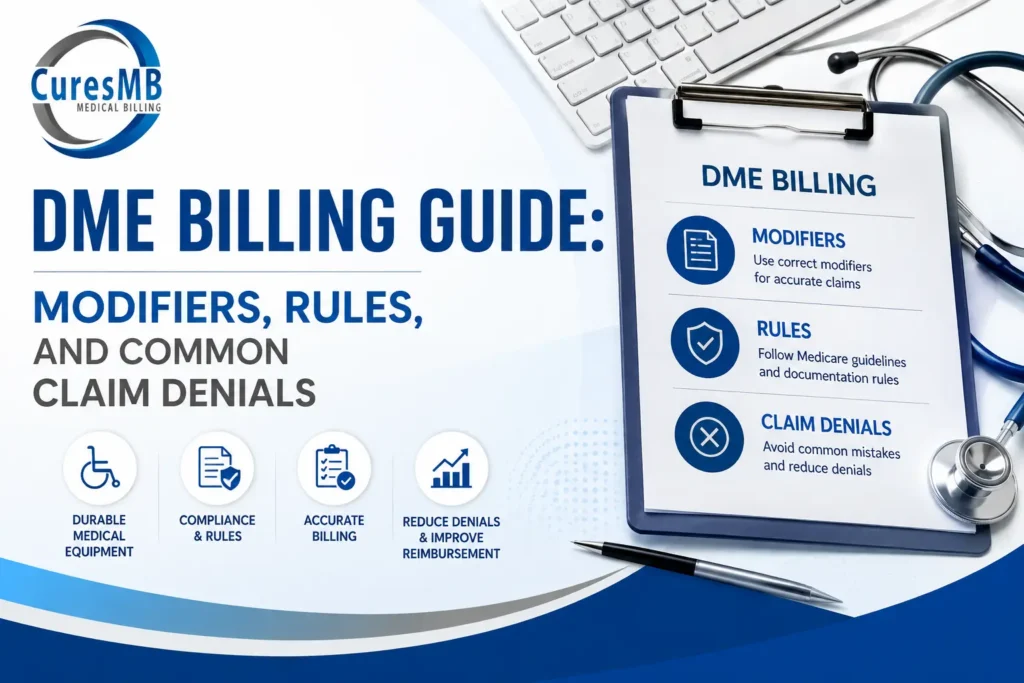
A wheelchair gets delivered, the patient is fitted, and then the claim bounces back over one missing modifier. That scenario plays out constantly in DME billing, and reliable DME billing services exist to catch these details before submission, not after a denial letter shows up. You did the clinical work. The patient needed the equipment. The claim still gets denied because a small administrative detail didn’t line up.
DME billing runs on different rules than standard medical billing. HCPCS Level II codes replace CPT codes, transactions can be rentals instead of purchases, and every payer applies its own documentation standard on top of Medicare’s baseline. That layered complexity is exactly why a single missing modifier or an incomplete certificate of medical necessity can derail an otherwise valid claim. Cures Medical Billing reviews these details as a standard part of every claim it processes.
Below, you’ll find the coding rules, the denial patterns, and the fixes that keep DME claims moving.
DME billing uses HCPCS Level II codes almost exclusively, covering items like wheelchairs, walkers, hospital beds, oxygen equipment, and CPAP machines. Unlike most medical claims, DME transactions can be structured as a rental, a capped rental, or an outright purchase, and each structure carries its own billing rules. Medicare, for example, applies a 13-month capped rental limit on many items, after which the billing rules shift entirely.
Modifiers carry more weight in DME billing than in almost any other specialty. Missing or incorrect modifier use is one of the single biggest denial drivers.
Get any one of these wrong, and the claim either denies outright or processes as unpayable, forcing a resubmission that delays cash flow.
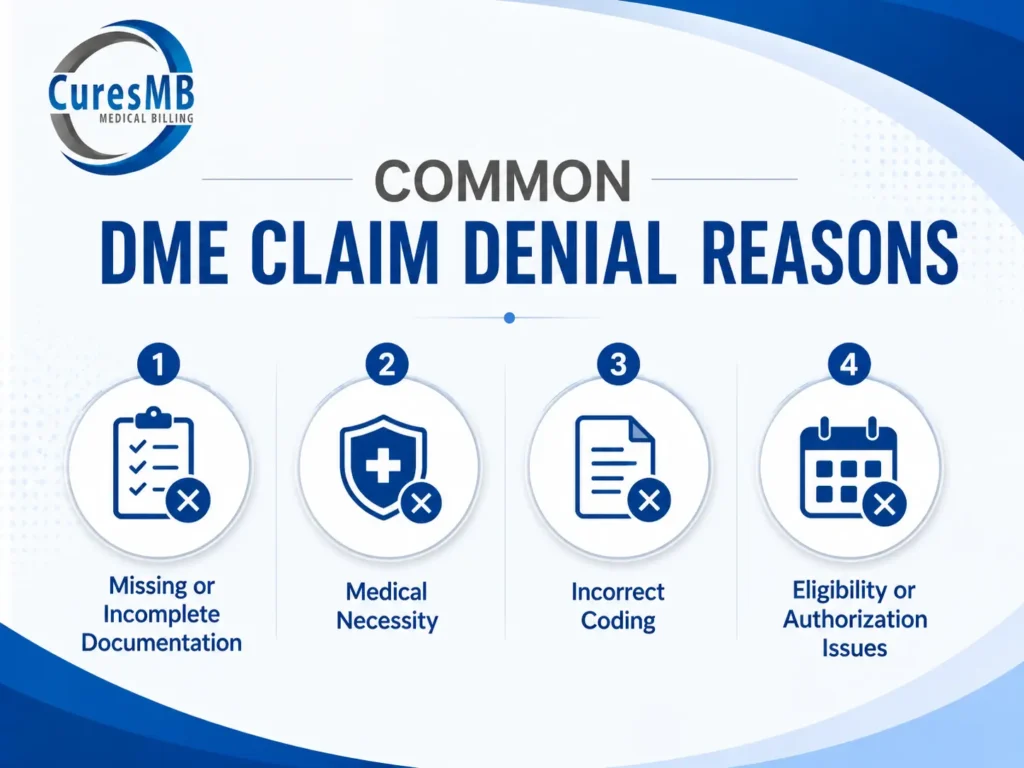
Missing or incomplete documentation tops the list. A certificate of medical necessity without a matching physician order, or a proof-of-delivery form that never made it into the file, gives the payer an easy reason to deny. Prior authorization gaps come next. Certain high-cost DME categories require approval before the equipment ships, and skipping that step almost guarantees a denial, regardless of clinical need.
Billing a rental as a purchase, or the reverse, creates another frequent problem. So does incorrect date-of-service entry, since delivery and dispensing dates must match the supporting documentation exactly. Even something as small as a misspelled patient name or an outdated Medicare Beneficiary Identifier can trigger a rejection that has nothing to do with clinical necessity.
Build a pre-submission checklist covering documentation, modifiers, and authorization status for every claim category you bill regularly. Track capped rental periods so your billing system flags the transition point automatically instead of relying on memory. Train staff specifically on modifier selection, since this single category causes more denials than almost any other DME billing issue.
Practices that build appeal templates for their top five denial reasons, whether that’s wrong modifier, missing documentation, or expired authorization, tend to recover revenue faster and prevent the same mistake from repeating on future claims.
A DME supplier delivers a power wheelchair and bills it with modifier NU, marking it as a new purchase, since that’s how the equipment was dispensed. The claim denies, and the reason code points to a documentation mismatch. On review, the certificate of medical necessity on file still lists the item as a capped rental from an earlier conversation with the patient’s care team, one that never got updated after the purchase decision changed.
Correcting the certificate of medical necessity to match the actual transaction type, then resubmitting with the right modifier, resolves the claim without any change to the clinical facts. Suppliers who build a standard cross-check between the CMN, the physician order, and the actual billing modifier before submission catch this exact mismatch before it ever becomes a denial.
A similar pattern shows up with oxygen equipment. Suppliers sometimes continue billing a capped rental rate well past the point required documentation should shift, or fail to track when a patient’s usage no longer meets ongoing coverage criteria. Reviewing active rental accounts against their capped rental timeline every month prevents both overbilling and the sudden revenue gap that comes from unexpected denials once that window closes.
Staff training deserves more attention than most DME suppliers give it. Modifier selection, in particular, tends to be treated as a quick administrative step rather than a skill that needs regular reinforcement. Suppliers who run short, recurring training sessions specifically on modifier logic and documentation requirements tend to see denial rates drop faster than those who rely on one-time onboarding alone. New hires especially benefit from reviewing real denied claims from the practice’s own history, since seeing an actual mismatch is often more effective than reading a general policy summary.
Suppliers who build this checklist into their intake process tend to see fewer first-pass denials across every equipment category they bill. Reviewing denial trends by equipment category every quarter, rather than treating each denial as an isolated event, also reveals which specific items or payers deserve extra attention going forward.
DME billing depends heavily on modifiers, rental versus purchase classification, and documentation like the certificate of medical necessity. Standard medical claims rely more on CPT codes and E/M documentation, with far less emphasis on equipment classification.
Most capped rental DME items follow a 13-month cycle, after which ownership typically transfers to the patient and the billing structure changes. Tracking that timeline closely prevents billing errors once the transition point arrives.
Build a specific appeal template for that denial reason, and just as importantly, fix the root cause in your intake or documentation workflow so the same error doesn’t repeat across future claims for other patients.
The Centers for Medicare & Medicaid Services updates HCPCS codes every January, and staying current with those changes protects your practice from denials tied purely to outdated coding. A small annual review saves far more time than fighting appeals throughout the year.
Tired of chasing down DME denials one claim at a time? Talk to Cures Medical Billing about a billing partner that catches these errors before they cost you revenue.