Your OBGYN practice can lose thousands every month to claim denials, and you may not even see it happening until the numbers show up at quarter’s end. OBGYN medical billing sits among the most denial-prone specialties in healthcare, and dedicated OBGYN billing services exist precisely because this specialty punishes small errors harder than most. Prenatal care, deliveries, well-woman exams, and gynecologic surgery each follow separate coding rules, and mixing them up is the fastest way to lose revenue. Payers deny nearly one in five OBGYN claims, and most of those denials come from a short list of repeat mistakes.
You may be wondering what accurate OBGYN medical billing actually requires. It starts with the global maternity package. This bundle covers routine prenatal visits, delivery, and the six-week postpartum check, all billed under one code such as 59400 or 59510. Bill it correctly, and payment arrives as a single lump sum. Bill it wrong, split it between two providers who didn’t coordinate, or add a separate charge for a visit already covered in the bundle, and the claim bounces straight back. As a full-service revenue cycle partner, Cures Medical Billing applies that same attention to detail across every specialty it supports.
A missing modifier on a same-day preventive exam and problem visit, a mismatched ICD-10 code on a Pap smear, or an unclear documentation note on an ultrasound can each trigger a denial on its own. Get the details right, though, and OBGYN medical billing becomes far more predictable. This guide walks through the codes, the common denial patterns, and the fixes that keep revenue flowing.
OBGYN medical billing spans two very different worlds under one specialty. Obstetric billing follows the pregnancy from the first prenatal visit through delivery and postpartum care. Gynecologic billing covers everything else: annual exams, screenings, contraceptive counseling, and surgical procedures for conditions like fibroids or endometriosis.
Most OBGYN CPT codes fall in the 56405 to 59899 range, though annual exams and problem visits pull from the standard E/M code set (99202–99215 and 99381–99397). Knowing which set applies to which visit, and never mixing the two without a modifier, protects your claims before they’re even submitted.
You don’t need to memorize every code in the book. You do need to know the handful that drive most of your revenue.
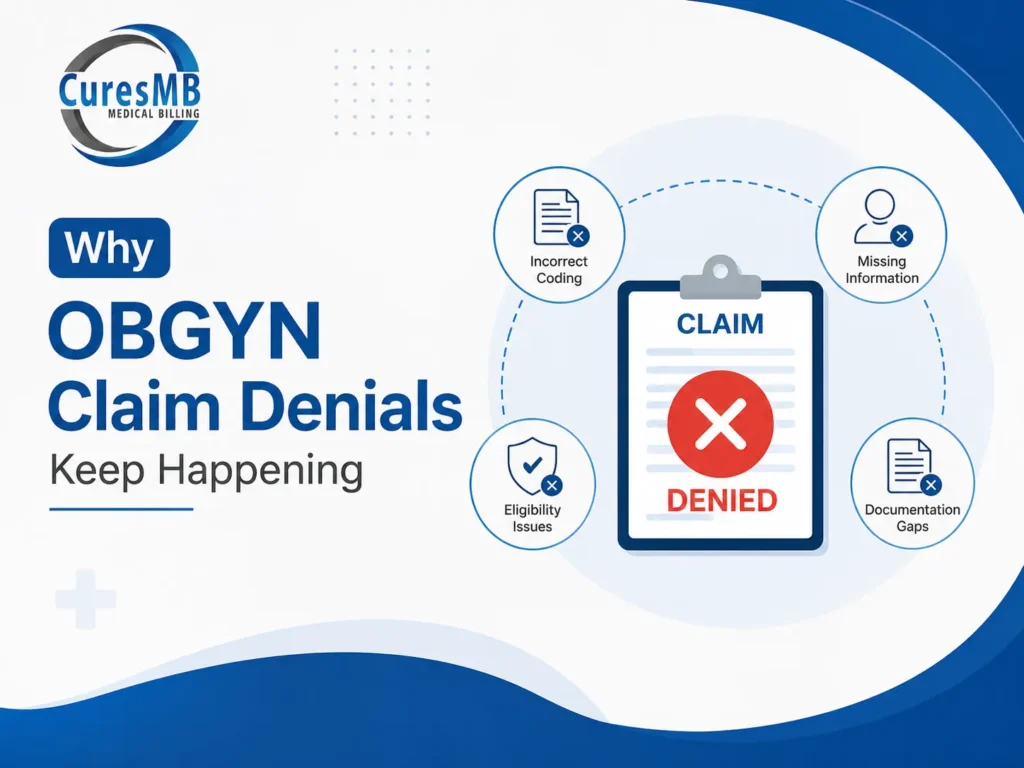
Denials rarely come from a single dramatic mistake. They come from small gaps that repeat across dozens of claims. Two physicians handling parts of a delivery without splitting the global code correctly. A visit count that looks unusual to a payer’s algorithm. An E/M visit for an unrelated concern, like a sinus infection during pregnancy, billed as part of the maternity package instead of separately.
Documentation gaps cause just as much damage. A vague note that says “follow-up ultrasound” without stating why the follow-up was needed gives a payer every reason to question medical necessity. Specific language, tied to the actual clinical reason, closes that gap before it becomes a denial.
Front-end accuracy prevents most of what happens on the back end. Verify insurance and screening coverage before the visit, not after. Train front-desk and clinical staff to flag same-day preventive-plus-problem visits so the modifier gets applied automatically. Run a coding audit every quarter, focused specifically on global maternity claims and high-volume codes like 99213 and 88175.
A practice that outsources its OBGYN medical billing to a specialty-aware team usually sees denial rates drop within the first billing cycle, simply because someone is reviewing every global package split and every modifier before the claim goes out the door.
Consider a common scenario. A patient comes in for her annual well-woman exam, and during that same visit, she mentions abnormal bleeding that needs its own workup. The provider documents both services clearly, but the claim goes out with only the preventive exam code attached. The payer processes it as a single visit, and the separate problem-focused portion of the encounter never gets reimbursed at all.
Once a billing team catches this pattern, the fix is simple. Adding modifier 25 to the problem-focused E/M code, alongside clear documentation showing the two services were separately identifiable, unlocks reimbursement for both parts of the visit. Practices that review this exact scenario across their claims history often find dozens of similar cases sitting unbilled or underbilled, each one a small but repeatable revenue leak.
The same logic applies to global maternity billing. A patient who transfers care mid-pregnancy, or who needs an unrelated E/M visit during her prenatal period, generates claims that look like they belong in the global package but actually don’t. Recognizing that distinction, visit by visit, protects revenue that would otherwise get absorbed into a bundle that was never designed to cover it.
Working through this list before submission, rather than after a denial, is usually the single fastest way to bring your OBGYN denial rate down.
Clean OBGYN claims typically process within 14 to 30 days, depending on the payer. Claims involving global maternity codes can take longer, since some payers hold the claim until delivery is confirmed and the full episode of care can be reviewed together.
Missing or incorrect modifiers on same-day preventive and problem visits cause a large share of OBGYN denials. Global maternity package errors, particularly around care transfers and multi-provider deliveries, come in as a close second.
It depends on claim volume and staff bandwidth. Smaller practices often find that the cost of an experienced coder or outsourced billing team pays for itself through recovered revenue and reduced denial rates, especially once global maternity and modifier errors start adding up.
According to the American College of Obstetricians and Gynecologists, coding accuracy and documentation quality remain among the top compliance concerns for OBGYN practices nationwide, a pattern that holds true across payers and practice sizes. Getting ahead of that pattern protects both your revenue and your staff’s time.
Ready to stop losing revenue to preventable OBGYN denials? Contact Cures Medical Billing today for a free billing audit and see exactly where your claims are breaking down.