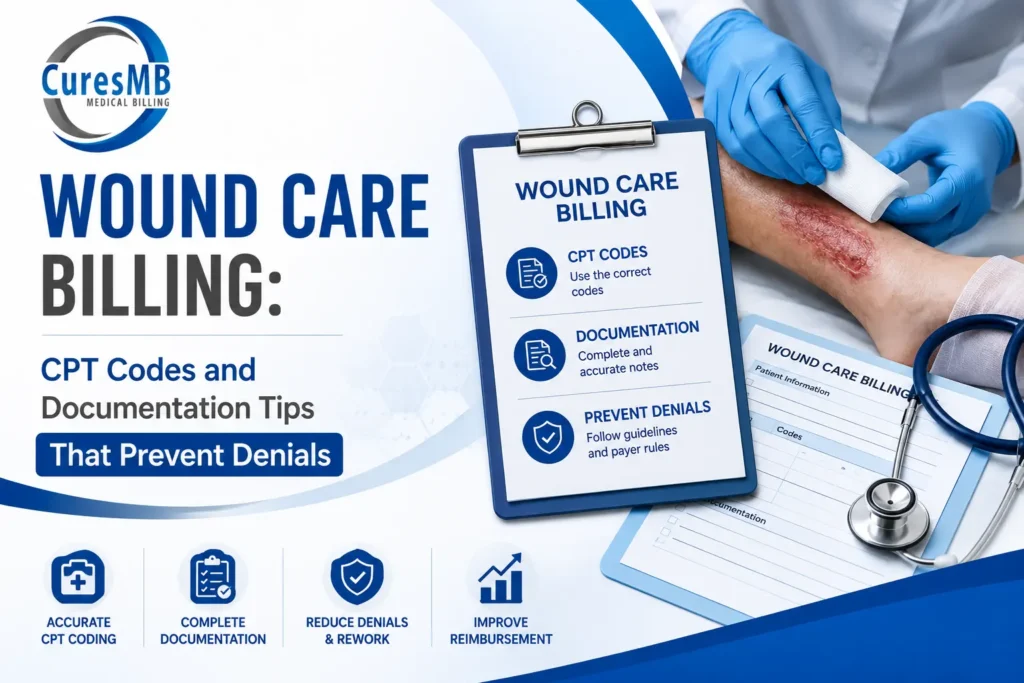
Wound care billing looks straightforward until you actually sit down and try to pick the right debridement code. Depth, surface area, technique, and documentation quality all shift which CPT code applies, and specialized wound care billing services build their entire process around getting these details right the first time. Wound care clinics, outpatient practices, and hospital-based programs all run into the same coding confusion, usually around debridement and negative pressure wound therapy.
You can fix most of this by understanding how the code families are actually organized. Selective debridement, surgical debridement, and active wound care management each follow distinct rules, and payers scrutinize wound care claims closely because the codes are so easy to misuse. Cures Medical Billing brings that same level of precision to every wound care claim it manages.
Wound care billing splits into three main categories. Active wound care management codes (97597, 97598, 97602) cover non-surgical debridement and topical treatments. Surgical debridement codes (11042–11047) apply when tissue removal reaches subcutaneous layers, muscle, or fascia. Negative pressure wound therapy uses separate codes (97605, 97606) based on wound size at the time of application.
Selective debridement (97597, 97598) removes devitalized tissue at the surface level, without cutting into deeper structures. The provider chooses what to remove, preserving healthy tissue in the process. Surgical debridement (11042–11047), by contrast, applies when the procedure reaches subcutaneous tissue, muscle, or fascia, and code selection depends on both depth and total surface area treated.
NPWT billing depends entirely on wound size measured at the time of application. CPT 97605 applies to wounds 50 square centimeters or smaller, while 97606 covers larger wounds. Documentation needs to include exact measurements, device type, and a clear clinical justification for continuing therapy.
Documentation gaps drive most wound care denials. A note that says “debridement performed” without specifying depth, technique, or wound size gives the payer nothing to validate. Payers can’t confirm medical necessity from vague language, and they won’t guess in your favor.
Combining incompatible codes causes the next biggest wave of denials. Billing CPT 97597 alongside 11042–11047 for the same wound on the same date gets rejected automatically, since selective and surgical debridement codes aren’t meant to overlap on one wound. Billing a simple dressing change as if it were a separate procedure creates similar problems, since routine dressing changes are typically bundled into the E/M visit or the debridement code itself.
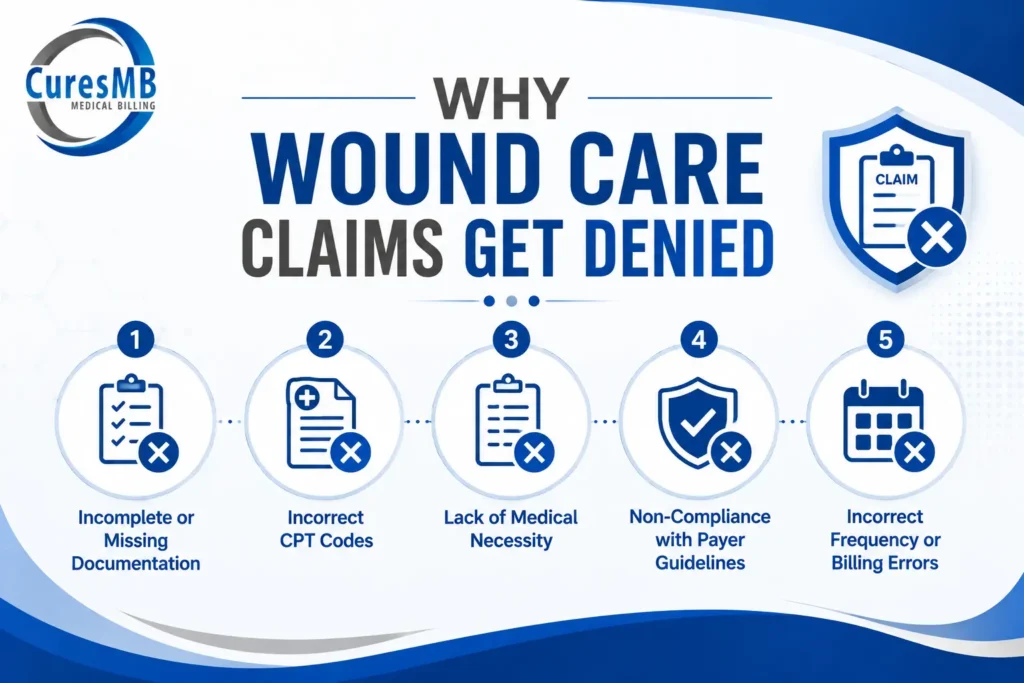
Every wound care note needs four things: exact wound measurements, the technique used, the tissue depth reached, and a follow-up plan. Skipping any one of these gives a payer room to question the claim. Training clinical staff to document consistently, using the same measurement method every visit, closes most of this gap before billing ever touches the claim.
Regular internal coding audits, focused specifically on debridement code selection, catch pattern errors before they repeat across dozens of claims. A quarterly review is usually enough to keep a wound care program’s denial rate well below the specialty average.
A wound care clinic performs surgical debridement reaching subcutaneous tissue on a diabetic foot ulcer, and the provider’s note simply says “debridement performed, wound improving.” The claim, billed under CPT 11042, comes back denied for insufficient documentation of medical necessity. Nothing about the treatment was inappropriate, but the note gave the payer nothing to verify against the code billed.
Once the clinic adopts a documentation template requiring exact wound measurements, tissue depth reached, and the specific technique used, the same type of claim clears without issue. Resubmitting the original claim with an amended note, supported by measurements taken at the time of service, recovers the reimbursement that the vague documentation had put at risk.
The same gap shows up often with negative pressure wound therapy. A clinic might apply NPWT consistently but fail to document wound size at each application, leaving no clear record of whether 97605 or 97606 was the correct code for a given date of service. Standardizing measurement documentation at every visit closes this gap for good.
Consistency across providers matters just as much as individual documentation quality. A wound care clinic with multiple providers often ends up with several different documentation styles, some detailed and some sparse, simply because no shared template exists. Standardizing a single note format across every provider, with required fields for measurement, depth, and technique, closes this gap without adding meaningful time to each visit. Clinics that make this change often see their denial rate improve within a single quarter, not because the care changed, but because the documentation finally matches what payers need to see.
Building these steps into your standard documentation workflow prevents the majority of wound care denials before they ever reach the payer. Reviewing a small sample of charts each month against this checklist, rather than waiting for a denial to prompt the review, keeps documentation quality consistent even as clinical volume grows. Sharing those review findings with the clinical team directly, rather than keeping them within the billing department alone, closes the loop and helps providers adjust their notes going forward.
Generally no, not for the same wound. Selective debridement codes and surgical debridement codes aren’t meant to overlap, and billing both together on one wound typically triggers an automatic denial.
Exact measurements, the depth of tissue reached, the technique used, and a clear follow-up plan. Vague language, without these specific details, is one of the most common reasons wound care claims get denied.
Wound size at the time of application determines which CPT code applies. Wounds 50 square centimeters or smaller use CPT 97605, while larger wounds use 97606, and documentation must include the measurement taken that day.
CMS coverage guidance on wound and ulcer care confirms that dressings applied during active wound care management are bundled into the procedure code itself and can’t be billed separately, a detail that trips up even experienced coders. Getting these small rules right protects revenue across every wound care visit you bill.
Struggling with wound care denials tied to debridement coding? Connect with Cures Medical Billing for a free audit of your current claims.