

10 Common Provider Credentialing Mistakes That Delay Insurance Payments

10 Common Provider Credentialing Mistakes That Delay Insurance Payments
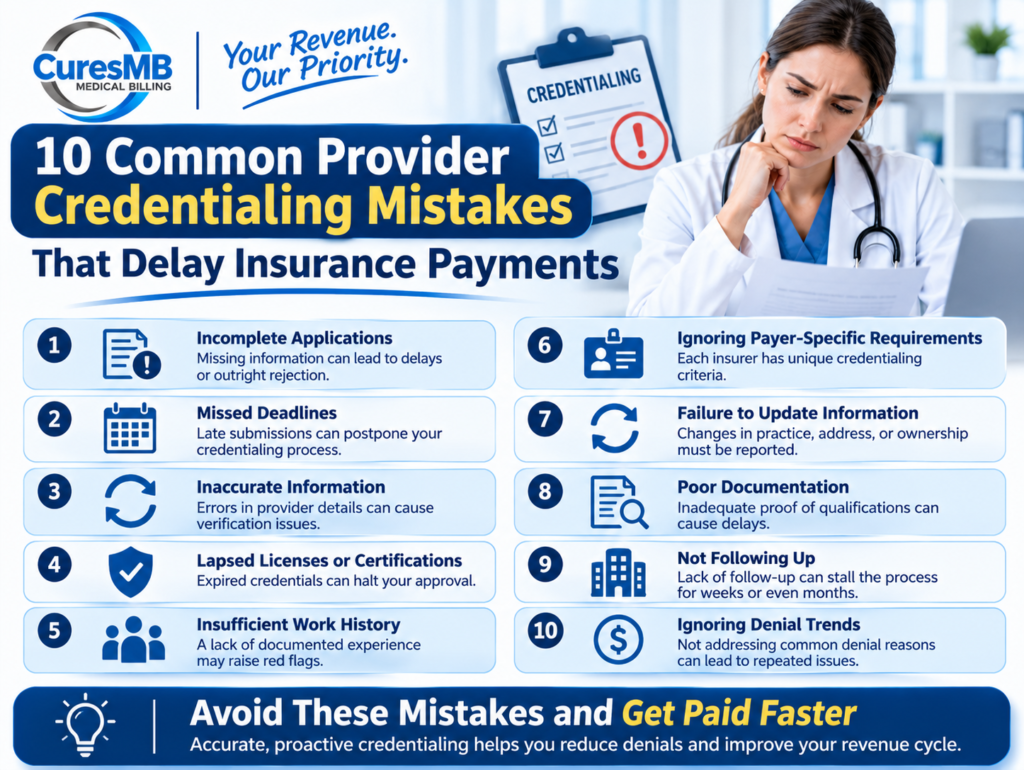
Many‍‍‍ providers find that when they’re not paid by insurance companies it is because of credentialing errors. For most healthcare providers getting paid by insurance companies takes months. But you’ll never receive payments at network rates until you’re fully credentialed. Even something as small as forgetting to sign a document, or mismatching a tax ID number, or an expired document will cause your revenue to grind to a halt for weeks. What makes it even worse is that the vast majority of credentialing delays are preventable.                                       In this post, we’ll break down the 10 most common credentialing mistakes that are causing you to fall behind on payments, why they happen and how to prevent them from ‍‍‍happening.

What Is Provider Credentialing?

Credentialing ‍is the process through which insurance companies and hospitals decide whether a provider is qualified, licensed and eligible to become a member of their health-care network. Credentialing information includes details about a physician’s education, training and work history, his or her licensing and malpractice insurance coverage. Licensing is different from credentialing because it refers to the ability to practice medicine and is granted by state medical boards. Insurance payers and health care facilities credential providers individually, so a physician would have to be credentialed with each insurance payer and facility for which he or she wants to bill or ‍‍‍practice.

How Credentialing Mistakes Affect Your Revenue

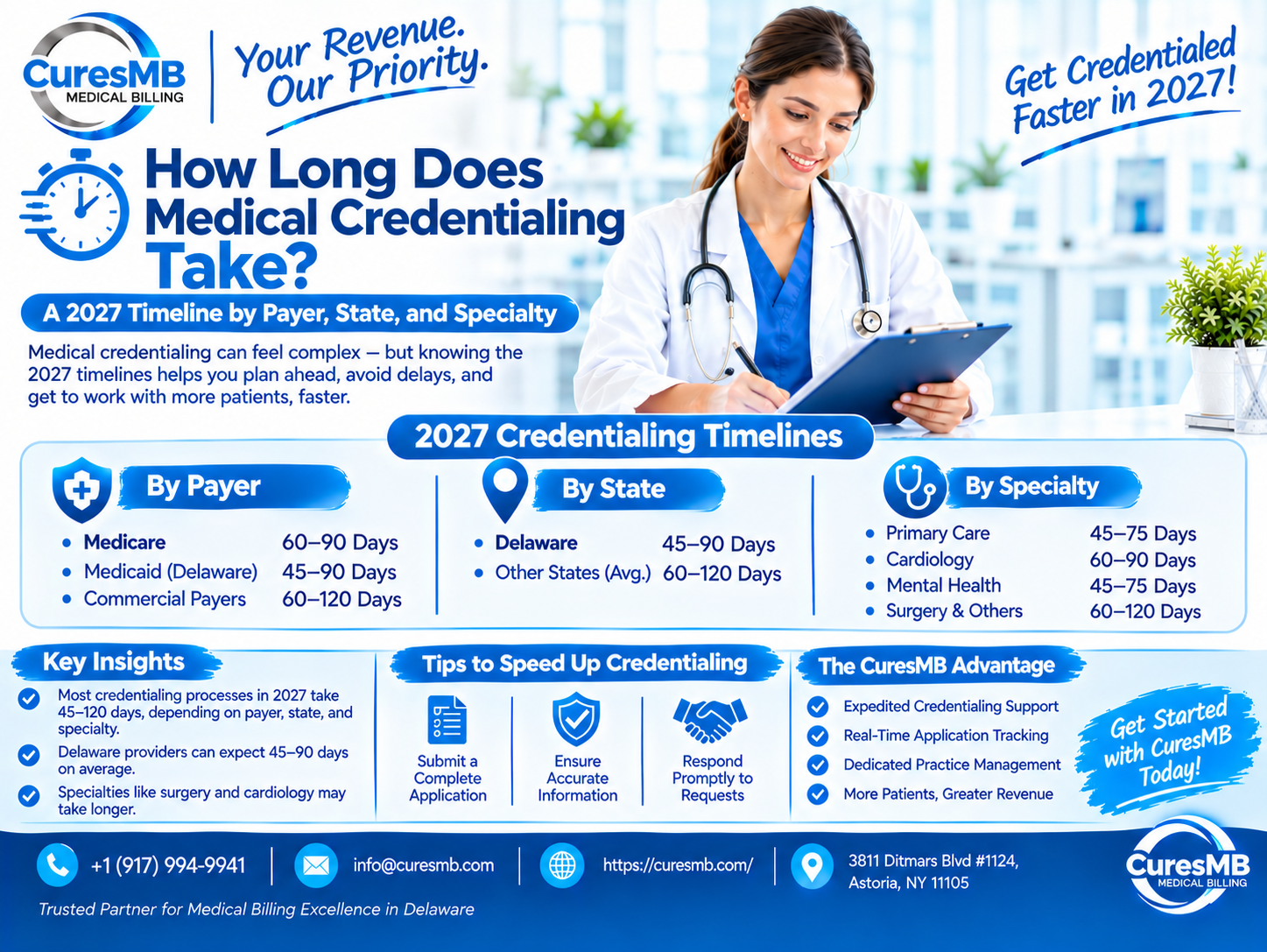
A‍‍‍ clean file will receive approval from a payer within 60-120 days. For files with one issue, such as a missing signature or expired document, the payer may hold back the approval for 2-6 weeks. Payers review files at their monthly committee meeting, so failing to provide the payer with all necessary information within the first cycle will cause the approval to be delayed another 30 days.Meanwhile, you have rent, payroll, and loans to pay, while waiting for revenue from your insurance claims to trickle in. It’s much easier to avoid these errors from the ‍‍‍outset.

10 Common Credentialing Mistakes to Avoid

1. Starting the Credentialing Process Too Late

Providers‍‍‍ often view credentialing as something that they need to worry about after they open up their new office. The credentialing process can take several months and those who start too late will have to work without getting paid by their insurance ‍‍‍companies.
How to fix it: You‍‍‍ can start preparing well in advance. You can call each of the payers that you’ll be receiving money from and ask them what their current processing time is. Start preparing as soon as you sign the job offer, rent a lease, file for business registration. Work from that worst case scenario ‍‍‍backwards.

Let's Talk

+1 (917) 994-9941

3811 Ditmars Blvd# 1124,

Astoria, NY 11105

Get Free Quote

Lead Form

2. Inconsistent Provider and Business Information

When‍‍‍ submitting applications to Medicare, you are required to use your business name. Medicare also will not accept your W-9 form as proof of your tax ID. Payers compare your information on every form you submit to them, including your license, DEA number, malpractice policy, NPI number, IRS forms, and applications. Even a small detail such as a missing middle initial, nickname, or outdated address can send your file back to ‍‍‍you.
How to fix it: Keep one master sheet, with your legal name, addresses, tax ID, NPI numbers and bank details and copy from it for every form. Make sure to finalize your business name, tax ID and banking details before you apply because later changes must be updated with every payer.

3. An Incomplete or Outdated CAQH Profile

The‍‍‍ provider information for commercial payers comes from CAQH. One missing field, an expired document, or failure to re-attest will cause a delay to all of your applications. Commercial payers will not be able to see your profile until you authorize them to do ‍‍‍so.
How to fix it: Complete every section, authorize each payer you apply to, and re-attest at least every 120 days.

4. Incomplete Applications and Expired Documents

Blank‍‍‍ boxes, missing signatures, employment gaps, and old paperwork are some of the reasons why your application may be sent back. Licenses, DEA certificates, malpractice insurance policies, board certifications, CLIA certificates, etc. can all ‍‍‍expire.
How to fix it: Put‍‍‍ your resume somewhere safe and make sure to note the date on which it expires. Have a co-worker or another person proofread each of your applications before sending them in, and make a note of why you had a gap in employment if ‍‍‍applicable.

5. NPI and Group Linkage Errors

If‍‍‍ incorrect Type 1 or Type 2 NPIs are billed or if an NPI is used that is not associated with the tax identification number of the group entity, claims will be ‍‍‍denied.
How to fix it: Confirm with each payer that your NPI, tax ID, and practice address are connected correctly before you submit claims.

6. Assuming Approval Means You Can Bill

An‍‍‍ approval letter might look like a finish line crossed, but you are not quite there yet. You still need an active contract, effective date and active link to your group with your payer. Even if you have all of the above, it is still possible that your claims are ‍‍‍denied.
How to fix it: First get your date and provider or contract ID in writing from each payer. Then send a test claim before you book patients, from that payer.

7. Relying on Retroactive Billing

Providers‍‍‍ should be seen sooner than later by insured patients as they won’t be reimbursed unless they have received their credentialing approvals. Although this seems risky, most commercial payers do not backdate services, and Medicare will reimburse for services rendered within the last 30 days in limited ‍‍‍circumstances.
How to fix it: Ask each payer about its retroactive billing policy and get the answer in writing before seeing its members.

8. Poor Follow-Up and Slow Responses

Sometimes,they don’t tell you in advance that they are making you respond to additional information requests. You have 30 days to respond or Medicare will reject your application. The lack of one item can hold up the processing of your entire ‍‍‍application.
How to fix it: Log when an application is submitted including the date, reference number, and contact person’s name. Contact the applicants every 10 to 14 days to see if there are any questions. Provide trackable submissions of applications. Respond to requests within a few ‍‍‍days.

9. Overlooking Payer, State, and Hospital Requirements

The‍‍‍ rules for each payer and state are different. Some payers require a peer reference, proof of hospital privileges, etc. Hospitals require their own approval process (usually a meeting of a committee a few times a month), so you can miss a whole month just because you missed the ‍‍‍deadline.
How to fix it: When‍‍‍ applying you have to fill out the checklist for each payer to ensure you have all the required documents and submit your application at the first application deadline. It is advisable to check with the committee at your hospital to know when the deadline ‍‍‍is.

10. Missing Recredentialing and Revalidation Deadlines

Credentialing doesn’t stop after you get approved. Commercial payers, credential providers, at least every three years. Medicare requires revalidation every five years. If you miss a deadline payments can stop. Services provided during the lapse might not be reimbursed.
How to fix it: Keep all CAQH dates, recredentialing dates, revalidation dates and license renewal dates on one shared calendar with reminders 90 to 180 days in advance. Keep all CAQH dates, recredentialing dates, revalidation dates and license renewal dates on one shared calendar with reminders 90 to 180 days, in advance.

What‍‍‍ to Do If Your Credentialing Is Already Delayed

Identify all your payers. Get the statuses of every application checked. Call each payer company to make sure they’ve identified the documents you need to submit. Then resolve their issues. It is important for records to note the date of contact and the person you speak to. If the processing time of a payer expires, then request to speak with a supervisor or provider representative.

How CuresMB HelpsYou Avoid Credentialing Mistakes

At CuresMB we handle your credentialing throughout so the common types of mistakes that you can commit will not interfere with your payments. This is why we can be your credentialing partner:
  • Data accuracy starting from the first day: We will be gathering and verifying your documents. Also, we will be able to set up your business profile. All of your information business name, tax identification number, NPI number, along with your addresses will match and will appear correctly in every document you submit to different payers.
  • Management, updates and support for CAQH: We finish up your CAQH profile, get the list of payers approved and make provisions for ongoing re-attestations.
  • Payer-ready applications: We handle the Medicare, Medicaid and commercial applications by following each payers checklist. Our main focus is to include all necessary documentation in the proper time frame. Nothing is omitted.
  • Consistent follow-up: We monitor each of the applications closely. The communication with the payers has a regular schedule and we handle application related information requests with prompt ‍‍‍response.
  • Billing readiness: We will confirm the dates and group linkages in writing before your first claim is sent out.
  • Ongoing monitoring: We keep track of license renewals recredentialing and revalidation dates so that your coverage never lapses. Your coverage stays active.
No one can control a player’s timeline but a clean well‑managed application gives you the fastest possible path to approval.. Because CuresMB handles both credentialing and medical billing your claims are ready to go as soon as you are approved.

Frequently Asked Questions (FAQs)

Clean applications are the ones that can be processed the quickest and most of them are done in less than two months. Sometimes, the process takes longer if a Medicaid claim is involved or corrections are needed in a commercial payer situation.
Late start of submitting applications and providing incomplete or erroneous information are two biggest things which cause delays.
Normally, you won’t be allowed to charge at in-network rates. With limited situations, one of the examples is that Medicare permits retroactive billing for up to thirty days. However, other types of payers do not have a single, uniform policy
CAQH profile should be updated at least once in every 120 days and also as and when necessary license, certificate, or insurance policy renew happen.
Most commercial plans require that your credentials are verified once every three years while for Medicare validation reauthorization is needed every five ‍‍‍years.

Conclusion

Credentialing‍‍‍ delays usually aren’t the result of bad luck, at least not most of them, but rather stem from avoidable problems such as delayed submission, providing inconsistent details, and missing the deadline. The strategy is to work well in advance, to be sure that each piece of information presented is accurate, and to carefully monitor each application in order to avoid financial flow disturbance through unwarranted credentialing delays. Want to avoid getting your credentialing hold-ups? Cures MB is just a call away and you can let our crew do the work whilst concentrating on your patients. ‍‍‍

Your Success Is Our Success

We are a team of national medical billing service experts based in Astoria, NY, committed to providing ongoing value to our customers. We leverage technology and implement best practices to provide high-quality and cost-efficient medical billing solutions from domestic locations, enabling customers to achieve their business goals. Cures Medical Billing is the best option for any medical billing needs.

Medical billing around Astoria, NY, and beyond is our core competency and our specialists will efficiently manage all your billing needs. Our medical billing specialists have over 12 Plus years of experience with all security technologies to ensure data integrity for our customers. Using our medical billing service, anyone can make their medical billing task less resource-consuming.

Start free 30 Days Trial Now

Contact Our RCM

Copyright © 2026 CuresMB – All Rights Reserved. Powered By AmigosIT

Wait! Before You Leave – Get a Free Billing Audit & Save Up to 20% of Your Revenue.

✅ Thank you! Your information has been submitted.

✅ Your request has been sent successfully!
×
Icon

Get a FREE Medical Billing Audit

×

Book A Free Medical Billing Audit