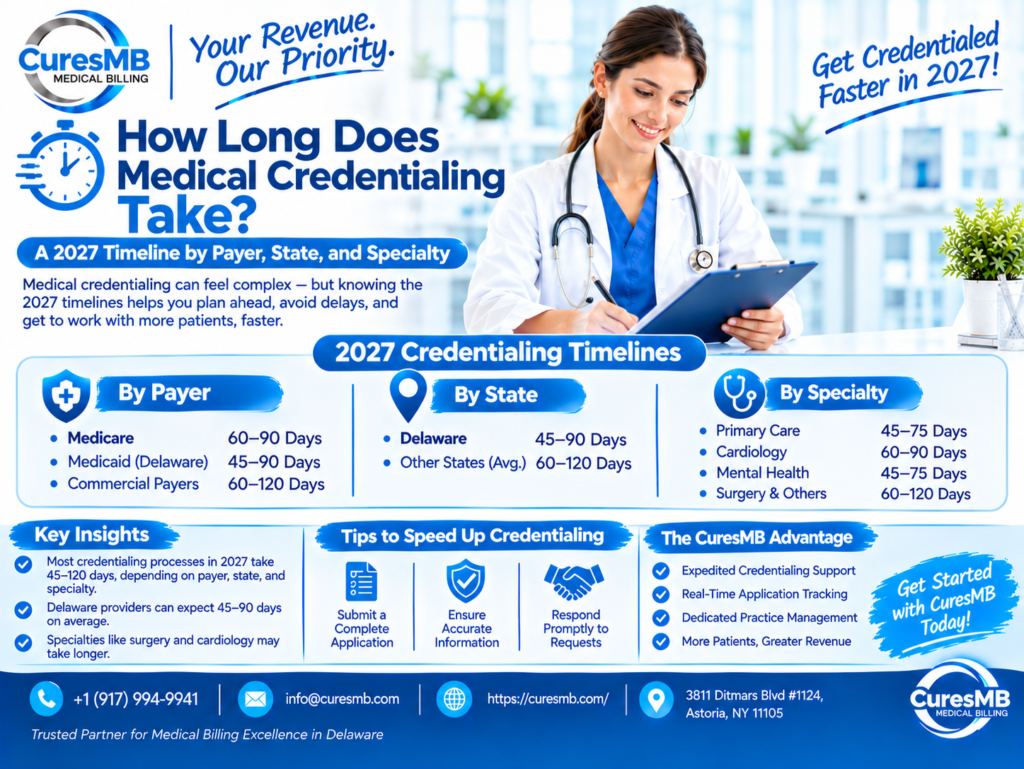
How Long Does Medical Credentialing Take? A 2027 Timeline by Payer, State, and Specialty

How long does Medicaid credentialing take?
In general, the first question every healthcare provider asks us is, “When can I start billing?”  If the payer has your application in paper at hand, the medical credentialing process would normally take 60-120 days. However, there are variations under this estimate. Medicare might get the job done in a couple of weeks whereas a commercial plan that is not doing very well could keep yours for four months or even more. Moreover, one missing document alone can cause your process to be delayed by an entire month without you even realizing it. By way of an illustration, we have presented below the length of a credentialing process categorized by payer, by location and by specialty so that you can set a realistic date for your start-up ‍‍‍activity.

Medical Credentialing Process: Step by Step

  1. Application Submission: The‍‍‍ healthcare provider completes and hands in an application form that contains personal details, education, professional qualification, license details, and employment ‍‍‍history.
  2. Document Collection: The‍‍‍ necessary papers consist of healthcare-related ones like medical licenses, certificates, malpractice insurance, NPI details and ID. ‍‍‍
  3. CAQH Profile Setup: The‍‍‍ provider either creates or updates their CAQH profile. They then give permission to insurance companies to view their records at their discretion whenever it is ‍‍‍necessary.
  4. Primary Source Verification: The‍‍‍ one paying, in this case, confirms that the medical facility and/or practitioner has the right level of education, clinical training, licenses, and certificates through checking the authentic ‍‍‍documents.
  5. Background and Exclusion Checks: Disciplinary‍‍‍ history, sanctions, and exclusion databases relevant to the provider are ‍‍‍examined.
  6. Credentialing Committee Review: The‍‍‍ credentialing department or committee of the insurance company, as they have established, reviews your application.
  7. Approval and Contracting: Once approved, the provider may have to execute a separate agreement with the insurance company prior to getting an appointment as in a network ‍‍‍provider.
  8. Enrollment and Billing Activation: The‍‍‍ provider fills in the last few payer enrollment details, double-checks the effective date, and then starts submitting ‍‍‍claims.

Credentialing Timeline at a Glance

Payer or process
Typical timeline
What affects it
Medicare (PECOS, no site visit)About 15 to 50 daysClean online application, no information requests
Medicare (with site visit)About 50 to 85 daysSite visits, fingerprinting, extra review
MedicaidRoughly 1 to 4+ monthsState agency speed, number of MCOs
Commercial insurance90 to 120 days, sometimes longerNetwork need, plan workload, contract stage
Hospital privilegesOften 60 to 120 daysCommittee meeting dates
CAQH re-attestationEvery 120 days (180 in Illinois)Missed dates make your profile unusable
RecredentialingAt least every 36 monthsEach payer runs its own clock
Medicare revalidationEvery 5 yearsCMS may request it earlier


Medicare ranges are based on published MAC processing times for online PECOS applications. Paper applications take longer, and any request for more information stops the clock until you respond.

Get Free Quote

Lead Form

Let's Talk

+1 (917) 994-9941

3811 Ditmars Blvd# 1124,

Astoria, NY 11105

How Does the Insurance Provider Affect Medical Credentialing Time?

How‍‍‍ Long Does Medical Credentialing Take for Medicare ‍‍‍Providers?

Medicare has to be the easiest to understand insurer, all rules being open. You submit the forms through the PECOS system with a CMS-855I for individual practices and CMS-855R or CMS-855B if a group is the billed entity. Online submission without a site visit can get approval in a few weeks. With site visits or development requests, processing takes about two or three months, respectively. Our biggest complaints about the patients’ errors involve the use of printed forms. The paper forms take more time to process and there are more opportunities to make mistakes resulting in rejection of a paper application. When you have the choice between submitting papers and filing online, always choose the ‍‍‍latter.

Medicaid Credentialing: How Long Does the Approval Process Take?

Medicaid‍‍‍ is more like two distinct processes than a single one. To begin with, a provider should register with the state agency that administers the Medicaid program. Next, in the majority of cases, they will also have to go through a separate process to get verified and credentialed with each one of the Medicaid managed care plans (MCOs) that the provider plans to take patients from. In other words, if a healthcare provider decides to join 5 different MCOs, they don’t need a single approval. Instead, they are expecting six sets of decisions. Each MCO has their own application forms, their reviewers and their own speeds of ‍‍‍processing.

How Long Does Commercial Insurance Credentialing Take?

Most‍‍‍ of the time you spend waiting is on commercial plans like Aetna, Cigna, UnitedHealthcare, and the local Blue Cross plan. For most plans, the typical review period is three to four months; however, with some of them it may even prolong your waiting period. Besides getting credentialed (proving you’ve been trained, licensed etc.) there is also the step of contracting (setting mutually agreed upon fee for service) which is a separate matter. You may have had yourself credentialed but you still may have problems with billing until such moment the contract has been fully ‍‍‍concluded.

Hospital Credentialing Timeline: How Long Does It Take to Obtain Privileges?

Hospitals‍‍‍ handle doctor credentialing via their own medical staff office and committee. The process could take longer if the hospital’s file review is on a monthly basis, for instance, and there is no meeting in between when you apply and the next one gets on the schedule, you end up waiting the whole period that is ‍‍‍lost.

How Long Does Medical Credentialing Take in Each State?

Hospitals‍‍‍ conduct their own credentialing via medical staff offices and committees. So even if you submit flawless files, you still have to wait until the committee meets again which you may be just too late.If meetings are every month and you have missed one, you have just lost four weeks without doing anything wrong. There is no credentialing timeline that all states would follow. The approval of your application might take place within two months in one state and twice as long in the other. The reasoning behind that is:

  • Medicaid structure: The more managed care plans the more applications will be coming in. On the contrary, in states where fee-for-service arrangement is the norm, processing happens more rapidly.
  • State licensing takes priority: If you have not been licensed by the state where you are going to work, insurance companies won’t accept your application. Obtaining a new license or transferring an existing one may already add up a few weeks or a month before they even consider starting their credentialing.
  • Network saturation: Big cities often face the provider shortage problem in certain specialties, and as a result, they may have to slow their panels down, or even close them.
  • Rules and regulations on state level: Concerning the use of CAQH. For example, CAQH grants providers in Illinois 180 days between their attestations instead of 120.
  • Local market share of payers: If a state happens to be controlled by a single or two huge plans, the speed of processing is the speed of the plans.
An actual case is as follows: According to a document released by Kentucky State regarding their providers, it takes the state Medicaid portal about 60 days to finish the state application. After that, each Medicaid Managed Care Organization takes from 60 to over 120 ‍‍‍days!

How Specialty Affects the Medical Credentialing Process

While‍‍‍ your specialty hardly changes the actual amount of paperwork you will be filling out, it affects greatly in terms of how payers handle your application.

Mental and behavioral health

There is a big demand for professionals in this field, but at the same time, some commercial plans have started to limit or even restrict their therapists and counselors panels especially in highly populated areas where therapists and counselors are in large supply to consumers. You will likely get more “panel closed” letters and should plan to appeal or apply to more plans.

Telehealth

A license in the state where the patient is located is a requirement and sometimes you also have to register independently with payers in different states where your services are available through telehealth. It is possible that a multi-state telehealth practice is running five to six credentialing projects simultaneously.

Physical, occupational and speech therapy

For therapists in private practice, enrollment through Medicare is quite easy, but commercial plans may require separate group and individual applications.

Chiropractic

Some healthcare plans direct chiropractors to third-party networks which results in a delay as an additional layer is put in place.

Durable medical equipment (DME)

Medicare DMEPOS suppliers are going through more inspections and also need to have a site visit arranged by the office, so their processing is much longer compared to that of a typical doctor.

Specialties other than primary care, such as urgent care, cardiology, gastroenterology, etc., hospital admission process, medical staff privileges and the setup of a medical group are often more important than the individual license application from the specialty ‍‍‍practitioner.

A Realistic Week-by-Week Timeline

Here’s what a typical new provider’s first four months look like when things go reasonably well:

When
What happens
Weeks 1 to 2Collect documents: license, DEA, board certification, malpractice insurance, CV with no gaps, NPI. Set up or update CAQH.
Weeks 2 to 3Submit Medicare through PECOS. Submit state Medicaid enrollment. Send commercial applications.
Weeks 3 to 8Payers verify everything with primary sources. Expect a few requests for missing or unclear information.
Weeks 4 to 10Medicare approval often lands here if there’s no site visit.
Weeks 8 to 16Commercial plans and Medicaid MCOs finish reviews. Contracts are sent for signature.
Weeks 12 to 18Effective dates are issued, and you’re loaded into payer systems so claims can pay.

If you’re counting from the day you start gathering documents, not the day the payer receives a clean file, four to six months is a safe planning window.

Why Does Medical Credentialing Take Longer Than Expected?

For‍‍‍ the most part, delays are not the fault of the payer. It has to do with little, avoidable gaps in the file:

  1. Expired or un-attempted CAQH profile: The payer cannot retrieve any information from an inactive profile so the file remains there.
  2. Mismatched details: Your name, address, license number or specialty code on your NPI record does not match the information given on your license and CAQH profile to a small degree.
  3. Unexplained gaps: A break in your work history of more than a few months typically prompts a request to explain the gap.
  4. No signatures or old documents: An expired malpractice certificate or an unsigned attestation page causes the file to be sent ‍‍‍back.
  5. Slow‍‍‍ responses: When a party in question raises a query, all processes are usually paused until the answer is given.
  6. Paper submissions: They take longer to be dealt with and are more likely to be mistaken at the same time.
  7. Group configuration problems: The practice’s tax ID, group NPI or Medicare group Enrollment is not complete, so individual providers will have trouble linking their ‍‍‍profiles.

How to Check Your Credentialing Status

You ‍are the person that should reach out to the payer for an update, not wait for them to call you. Keep checking regularly on the schedule you follow.

  • Medicare: Go to PECOS and look for your application tracking number, or phone your Medicare Administrative Contractor (MAC) and mention your application tracking number when you ask where your application is.
  • Medicaid: Almost all Medicaid agencies have a web portal for providers where you can check the status and progress of your application online, so it’s a good idea to look there first.
  • Commercial plans: Reach out to the provider services or the network management team and inquire about the status of your account, the reference number, and the name of the reviewer.
  • CAQH: Access your dashboard and verify that your profile is shown as ‘complete’ and ‘attested.’ Also, you should make sure that the payers that you are contracted with have permission to access it.
Record details of every phone call you make with the payer: date of the call, the person you spoke to, the number they gave you and what the conversation was all about. If your case is not progressing, make sure to bring it up regularly after about one or two ‍‍‍weeks.

What If a Payer's Panel Is Closed?

A‍‍‍ “closed panel” letter means your provider’s insurance plan has concluded that it already has plenty of providers in your chosen field and region. That doesn’t necessarily mean there are no options left. Here are your potential recourse avenues:
  • Request a written explanation of the denial.
  • File an appeal this is a good chance if you can provide a feature the insurance network doesn’t offer like evening hours, speaking two languages, or being a sub-specialist in a certain field and/or being located in an underserved area.
  • Apply again as panels open throughout the year.
  • Get yourself enrolled by joining a group or facility that is already covered under the ‍‍‍plan.

How to Speed Up Credentialing: A Simple Checklist

  • Settle‍‍‍ down with the paperwork at least 4-6 months before your anticipated start date.
  • Get your profile on CAQH done and attested by you only right before you begin applying.
  • Double-check that your name, address and the type of healthcare profession match on NPPES, your license and CAQH.
  • You can electronically submit your application for Medicare through the PECOS system; there is no paper form to fill out.
  • Your job history should be well explained to them from start to finish.
  • Create a folder which stores digital copies of each one of your licenses, certificates and insurance policies.
  • Respond to requests from payers within a couple of days.
  • Stay in touch with every payer through regular check-ins every one or two weeks.
  • Credentialing approval and signing contracts are considered separate processes so keep track of them ‍‍‍separately.

How does CureMB’s credentialing team handle the work?

Credentialing  may seem to take ages but generally comes up to expectations that the providers are able to make their way through. Allow yourself three to four months, maintain your CAQH profile to date and respond to every payer request within a day or so. That routine saves from one of the most expensive first-year mistakes: seeing patients you can’t bill for. Every week you are not credentialed you miss on a week of revenue which you won’t get back. If you would rather spend the time seeing patients than making phone calls to payers, Cures MB can easily handle the rest by doing it for you. We have a great team here that is focused solely on preparing error-free applications, keeping track of the insurance carriers and following up until you get approved and ready to bill. If you want to get rolling immediately, then schedule your complimentary credentials consultation today and our team will tell you precisely how much time it should take to get your credentials and also outline the steps you need to begin the ‍‍‍process.

Frequently Asked Questions (FAQs)

Most providers can expect 60 to 120 days from a complete application. Commercial plans tend to take the longest, and Medicare is usually the fastest.

An online PECOS application without a site visit often takes about 15 to 50 days. With a site visit or extra review, it’s closer to 50 to 85 days. Any request for more information adds time.
It depends on your state. State enrollment may take a month or two, and each Medicaid managed care plan can add another one to four months.
You can see patients, but you may not be paid in-network for them. Some payers allow retroactive effective dates and some don’t, so check each plan’s rules before you schedule insured patients.
Usually when the payer has a complete application. If something is missing, most payers don’t count the days until you send it.
At least every three years with most health plans, with CAQH re-attestation every 120 days and Medicare revalidation about every five years.
No one can force a payer to review faster. A good credentialing team saves time by sending clean, complete files the first time and following up consistently, which is where most delays come from.

Discover Cures Medical Billing Services Across Different States

Your Success Is Our Success

We are a team of national medical billing service experts based in Astoria, NY, committed to providing ongoing value to our customers. We leverage technology and implement best practices to provide high-quality and cost-efficient medical billing solutions from domestic locations, enabling customers to achieve their business goals. Cures Medical Billing is the best option for any medical billing needs.

Medical billing around Astoria, NY, and beyond is our core competency and our specialists will efficiently manage all your billing needs. Our medical billing specialists have over 12 Plus years of experience with all security technologies to ensure data integrity for our customers. Using our medical billing service, anyone can make their medical billing task less resource-consuming.

Start free 30 Days Trial Now

Contact Our RCM

Copyright © 2026 CuresMB – All Rights Reserved. Powered By AmigosIT

Wait! Before You Leave – Get a Free Billing Audit & Save Up to 20% of Your Revenue.

✅ Thank you! Your information has been submitted.

✅ Your request has been sent successfully!
×
Icon

Get a FREE Medical Billing Audit

×

Book A Free Medical Billing Audit